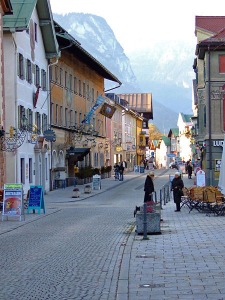
Image Credit Wikipedia Commons
When husband and I decided to buy a piece of furniture painted in the traditional Bavarian folk-art style, or biggest obstacle was a bad salesperson.
Living in southern Germany, my husband and I came to love the Bauernmalerei folk-art furniture style. We traveled to Garmisch-Partenkirchen, situated at the foot of the Zugspitze Alp, where we hoped to select and order a hand-made Bavarian keepsake.
This was in the late 1980’s when a strong US-Dollar motivated hordes of American tourists to visit picturesque Germany. Beautiful Garmisch, with its painted buildings and cobblestones streets, was a popular destination.
We found a small store that had beautiful hand-painted armoires that we immediately fell in love with. Since the shop owner was studiously ignoring us, we sought him out and asked him, in our fluent German, what the price ranges.
“Teuer [Expensive],” he responded.
Matt and I looked at each other. Ok, so he didn’t particularly like Americans. He probably had tons come into his shop and leave again without purchasing anything. We got it. As ex-pats, we sometimes cringed at the behavior of busloads of US-tourists. Un-offended (or not very offended), we persevered.
“How expensive?” I asked.
“Sehr [Very].”
At this point, I was torn between wanting to giggle and wanting to stomp out. Luckily, Matt remained calm.
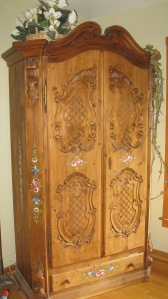 “Could you be more exact?” he asked, pointing at an exemplar that we had particularly admired. “How much would one like this cost?”
“It depends.”
Yep. He hated American tourists, or possibly any tourist, or possibly anyone.
“Depends on what?” I asked testily, fully expecting him to tell me it depended on how much he hated the individual wanting a quote.
He grumpily pointed out features of carving and painting that influenced pricing. Finally, after pointing out the features we liked, we got a price out of the man.
Despite his misogynist temperament, we loved his work and decided to order an armoire from him. We still love it, twenty-plus years later. When visitors admire it, we enjoy telling them how it was “very expensive.”
© Laura Hedgecock 2013
Interested in sharing your memories? My website, Treasure Chest of Memories, has tips, resources, and a blog about memory sharing.


 Memories in the Wind